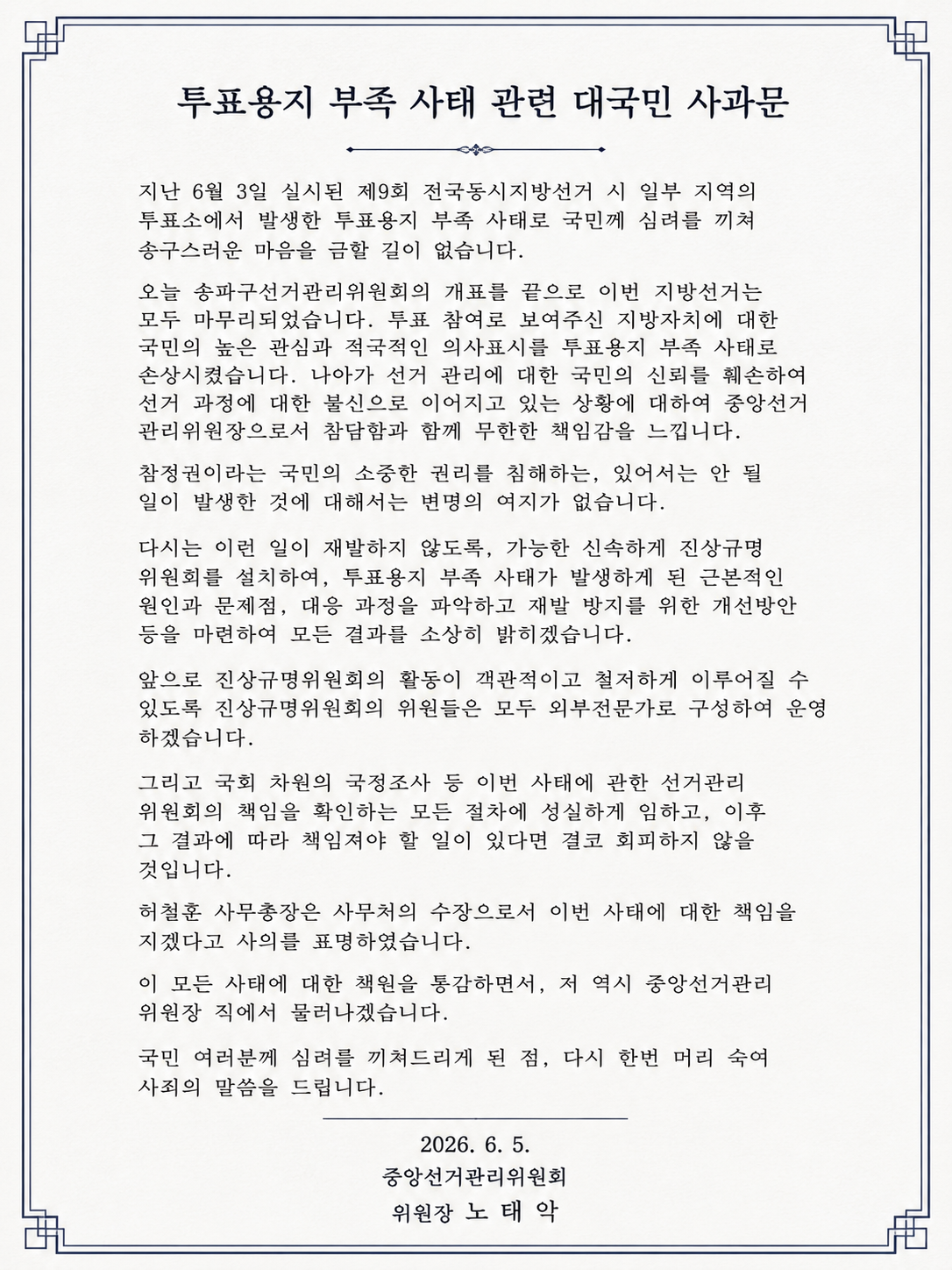
사진 = 중앙선거관리위원회
110% 확보 예산, 현장 인쇄율은 49.3% — 두려움이 부른 실수, 불신이 키운 봉쇄
2026년 6월 6일 | 더 미디어저널리스트 종합 심층분석
“대기번호 110번입니다” — 오후 1시, 잠실에서 민주주의가 멈췄다
6월 3일 제9회 전국동시지방선거 본투표일.
서울 송파구 일대 일부 투표소에서는 이례적인 장면이 연출됐다. 유권자들은 긴 줄을 서야 했고, 일부 투표소에서는 대기번호가 세 자릿수를 넘어섰다. 현장 곳곳에서는 투표용지 부족에 대한 항의가 이어졌다.
이날 서울 송파구 12곳, 강남구와 광진구 각 1곳 등 총 14개 투표소에서 투표용지가 부족해지는 사태가 발생했다. 일부 투표소에서는 투표가 일시 중단됐고, 선관위는 투표 마감 시간을 밤 10시까지 연장했다.
그러나 혼란은 거기서 끝나지 않았다.
그날 밤부터 잠실7동 제2투표소 앞에서는 투표함 반출을 둘러싼 대치가 시작됐고, 결국 약 35시간 동안 투표함이 개표소로 이동하지 못하는 초유의 상황이 벌어졌다.
50% 인쇄 기준, 그리고 49.3%
선관위는 이번 지방선거에서 본투표용지 인쇄 기준을 선거인 수의 50% 수준으로 운영했다. 이는 과거 주요 선거에서 적용됐던 60~70% 수준보다 낮아진 기준이다.
특히 잠실7동 제2투표소는 선거인 수 3,856명 기준으로 1,928매가 필요했지만, 실제 준비된 수량은 1,900매였다. 결과적으로 인쇄율은 49.3%에 머물렀다.
문제는 전체 물량이 부족했던 것이 아니라 배분 시스템이었다.
보고서에 따르면 송파구 전체에는 약 4만 장의 투표용지가 남아 있었지만, 부족한 투표소에 신속하게 재배분하는 체계가 제대로 작동하지 않았다.
선관위는 일부 부정선거 의혹 제기 세력의 “잔여 투표용지 악용” 주장 등을 의식해 잔여 용지를 최소화하려 했던 것으로 알려졌다. 그러나 결과적으로 그 결정이 더 큰 논란을 낳았다.
오후부터 이어진 경고, 늦어진 대응
현장 공무원들은 투표용지 부족 조짐을 일찍부터 감지했던 것으로 알려졌다.
송파구 일선 투표소에서는 오후부터 투표용지 잔량 부족 상황이 공유됐지만, 현장 대응은 충분히 이뤄지지 못했다는 지적이 나온다.
결국 일부 투표소는 투표가 중단됐고, 유권자 불만은 급속도로 확산됐다.
이 과정에서 드러난 것은 단순한 인쇄량 문제가 아니라 위기 대응 체계의 부재였다.
행정 실수가 정치가 되는 순간
투표 종료 이후 잠실7동 제2투표소 앞에는 투표함 반출을 반대하는 시민들과 유튜버, 정치인들이 모여들기 시작했다.
보고서에 따르면 부정선거 의혹을 제기해 온 일부 활동가들과 정치권 인사들이 현장에 결집했고, 개표 중단과 재선거를 요구하는 목소리가 이어졌다.
처음에는 수십 명 규모였던 집회는 시간이 지나면서 수백 명 규모로 확대됐다.
행정 실패는 어느 순간 정치적 갈등의 중심으로 이동했다.
투표용지 부족이라는 사실 자체보다 “왜 이런 일이 발생했는가”에 대한 불신이 더 빠르게 확산된 것이다.
35시간의 봉쇄
6월 5일 오전 경찰은 18개 기동대 약 1,000명을 투입해 현장 정리에 나섰다.
시위대는 스크럼을 짜고 저항했고, 경찰은 강제 해산 절차를 진행했다. 약 35시간 동안 이동하지 못했던 투표함 2개는 결국 오전 8시 54분 개표소로 옮겨졌다.
이후 올림픽공원 개표소에서 개표가 재개됐고 서울시장 선거 결과도 최종 확정됐다.
선관위를 향한 네 개의 칼
사태가 커지자 선관위 수뇌부는 책임을 인정했다.
노태악 중앙선거관리위원장은 사의를 표명했고, 오민석 서울시선관위원장과 허철훈 사무총장도 사퇴 의사를 밝혔다. 외부 전문가 9명으로 구성된 진상규명위원회도 출범했다.
여기에 국정조사 추진, 경찰 수사, 각종 법적 대응까지 이어지면서 선관위는 창설 이후 가장 강한 책임론에 직면하게 됐다.
왜 35시간이 되었는가
투표용지 부족은 행정 문제다.
그러나 잠실7동의 35시간은 단순한 행정 문제가 아니었다.
행정 실수가 투표함 봉쇄로 이어지기 위해서는 그 사이를 연결하는 무언가가 필요하다.
그것은 신뢰였다.
정확히 말하면 신뢰의 부재였다.
선관위를 신뢰하지 못하는 시민들, 선거 절차를 의심하는 시민들, 그리고 그 불신을 증폭시키는 정치적·사회적 환경이 결합하면서 작은 행정 실패는 전국적 논란으로 확대됐다.
선관위는 음모론을 의식해 잔여 용지를 줄이려 했고, 그 결정은 오히려 더 큰 음모론의 근거로 소비됐다.
아이러니하게도 선관위가 피하려 했던 것이 결국 현실이 된 셈이다.
잠실7동이 남긴 질문
투표함은 개표소에 도착했다.
개표는 끝났고 당선자는 확정됐다.
그러나 잠실7동이 남긴 질문은 아직 끝나지 않았다.
왜 선관위는 인쇄 기준을 낮췄는가.
왜 부족 징후를 제때 해결하지 못했는가.
왜 시민들은 투표함을 믿지 못했는가.
그리고 더 근본적인 질문.
왜 하나의 행정 실수가 한국 사회를 35시간 동안 멈춰 세울 만큼 거대한 불신으로 번질 수 있었는가.
잠실7동 35시간은 단순한 선거 사고가 아니었다.
그것은 한국 사회가 선거 제도와 공공기관을 얼마나 신뢰하고 있는지 보여준 시험대였다.
답은 아직 나오지 않았다.
그러나 질문은 남았다.
잠실7동 35시간은 선관위의 행정 실패를 넘어, 한국 민주주의의 신뢰가 어디까지 흔들리고 있는지를 보여준 사건으로 기록될 것이다.
[Why the NEC?] From Ballot Shortages to Ballot Box Blockades: What the 35 Hours in Jamsil 7-dong Left Behind
Budgeted for 110%, Printed at 49.3% — A Mistake Driven by Fear, A Blockade Fueled by Distrust
June 6, 2026 | The Media Journalist Special Report
“I’m Number 110 in Line” — The Moment Democracy Stalled in Jamsil
June 3, 2026, Election Day for South Korea’s 9th Nationwide Local Elections.
At several polling stations in Seoul’s Songpa District, voters encountered an unusual scene. Long lines stretched outside polling places, and waiting numbers climbed into the triple digits. Complaints quickly spread as ballot papers began running out.
By the afternoon, ballot shortages had been reported at 14 polling stations across Seoul, including 12 in Songpa District and one each in Gangnam and Gwangjin. Voting was temporarily suspended at some locations, forcing the National Election Commission (NEC) to extend voting hours until 10 p.m.
But the confusion did not end there.
That night, a standoff began outside Polling Station No. 2 in Jamsil 7-dong. What followed was an unprecedented 35-hour blockade that prevented two ballot boxes from reaching the counting center.
The 50% Printing Rule — And the Reality of 49.3%
For this election, the NEC adopted a ballot printing standard of approximately 50% of registered voters, lower than the 60–70% range commonly used in previous national elections.
Jamsil 7-dong Polling Station No. 2 became the most symbolic example of the problem. With 3,856 registered voters, the station should have received 1,928 ballots under the 50% rule. Instead, only 1,900 ballots were prepared, resulting in an actual printing ratio of 49.3%.
The issue was not an overall shortage of ballots.
According to reports, Songpa District still had roughly 40,000 unused ballots available. The real failure was the inability to redistribute those ballots quickly to polling stations running out of supplies.
The NEC reportedly sought to minimize surplus ballots in response to repeated claims from election-fraud activists that leftover ballots could be misused. Ironically, that effort produced an even greater controversy.
Warnings Came Early, Responses Came Late
Signs of trouble appeared well before voting ended.
Election workers and local officials reportedly began sharing concerns about dwindling ballot supplies throughout the afternoon. Yet meaningful intervention failed to materialize.
As ballot stocks continued to shrink, frustration among voters grew rapidly. By the time voting was suspended at several locations, public anger had already spread beyond the polling stations themselves.
What emerged was not merely a printing problem, but evidence of a broader failure in crisis management.
When an Administrative Error Becomes Political
After voting closed, crowds began gathering outside Jamsil 7-dong Polling Station No. 2.
According to reports, election-fraud activists, political figures, and online broadcasters converged on the site, demanding that vote counting be halted and that a new election be considered.
What began as a small gathering gradually expanded into a large-scale political demonstration.
The issue was no longer simply about missing ballots.
It had become a question of trust.
For many participants, the ballot shortage was interpreted not as an isolated administrative mistake but as evidence supporting deeper suspicions about the election system itself.
Thirty-Five Hours of Blockade
On the morning of June 5, police deployed approximately 1,000 officers from 18 riot-control units to clear the site.
Protesters formed human chains and resisted removal. Police ultimately carried out a forced dispersal operation.
At 8:54 a.m., the two ballot boxes that had remained trapped for roughly 35 hours were finally transported to the counting center.
Vote counting resumed shortly afterward, and the Seoul mayoral election result was officially confirmed.
Four Investigations Pointing at the NEC
As criticism intensified, senior election officials accepted responsibility.
NEC Chairperson Noh Tae-ak announced his resignation, while Seoul Election Commission Chair Oh Min-seok and Secretary-General Heo Cheol-hoon also stepped down. An independent fact-finding committee composed of nine external experts was established.
At the same time, calls for a parliamentary investigation, police inquiries, and legal actions gained momentum.
The NEC now faces one of the most serious crises of public confidence in its history.
Why Did It Become 35 Hours?
A ballot shortage is an administrative problem.
The 35-hour blockade in Jamsil, however, was something more.
Between an administrative mistake and a political confrontation lies a crucial factor:
Trust.
Or, more precisely, the absence of it.
Distrust in election management, distrust in institutions, and distrust in official explanations created the conditions for a local administrative failure to become a national controversy.
The NEC attempted to reduce surplus ballots out of concern that unused ballots would fuel conspiracy theories. Instead, the shortage itself became the catalyst for even greater suspicion.
In trying to avoid one crisis, it unintentionally created another.
The Questions Jamsil Leaves Behind
The ballot boxes reached the counting center.
The votes were counted.
The winners were declared.
Yet the questions remain.
Why did the NEC lower its printing threshold?
Why were warning signs not addressed in time?
Why did so many citizens lose confidence in the election process?
And perhaps the most important question of all:
How could a single administrative failure grow into a 35-hour national controversy?
The events in Jamsil 7-dong were more than an election mishap.
They became a test of public trust in South Korea’s democratic institutions.
The answers have yet to emerge.
But the questions remain.
The 35 hours in Jamsil will be remembered not only as a failure of election administration, but also as a moment that revealed the fragile state of trust underpinning Korean democracy.
The Media Journalist
“Journalism That Questions the Essence of Our Times.”
저작권자 © '더미디어저널리스트' 무단전재 및 재배포, AI학습 및 활용 금지
작성자 소개