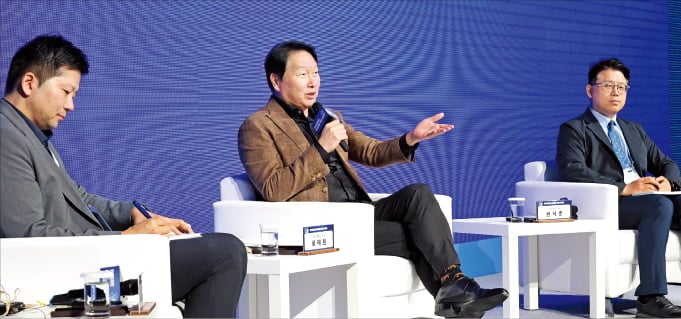
<대한상의 제주포럼 AI 대담,이재욱 서울대 AI연구원장(왼쪽), 권석준 성균관대 교수가 참석했다. 대한상의 제공>
최태원 대한상공회의소 회장이 인공지능(AI) 시대 한국 경제의 새로운 성장 전략으로 ‘지능(Intelligence) 수출’을 제시했다. 반도체와 제조업 중심의 수출을 넘어 AI 모델과 서비스 등 지능 자체를 글로벌 시장에 공급하는 경쟁력을 갖춰야 한다는 것이다.
최 회장은 17일 제주 신라호텔에서 열린 제49회 대한상공회의소 제주포럼 AI 특별대담에서 이 같은 견해를 밝혔다. 이날 대담은 ‘한국경제의 AI 성장을 위한 아젠다’를 주제로 진행됐으며, 이재욱 서울대 AI연구원장이 사회를 맡고 권석준 성균관대 교수가 패널로 참석했다.
“제품 넘어 AI 모델·서비스 경쟁”
최 회장은 AI 시대에는 제조업과 반도체 중심의 성장 전략을 넘어 AI 모델과 응용 서비스 등 ‘지능’이 새로운 경쟁력이 될 것이라고 강조했다.
그는 한국이 AI 기술을 활용한 새로운 부가가치를 창출하고 이를 세계 시장으로 확장하는 전략이 필요하다며, 앞으로는 제품뿐 아니라 지능을 수출하는 시대를 준비해야 한다고 말했다.
AI 경쟁력은 산업 생태계가 좌우
최 회장은 AI 경쟁력을 높이기 위해서는 기술 개발만으로는 충분하지 않다고 설명했다.
AI 산업이 성장하기 위해서는 컴퓨팅 인프라와 데이터 활용 환경, 반도체를 비롯한 산업 생태계가 함께 뒷받침돼야 한다며 국가 차원의 준비가 중요하다고 강조했다.
반도체 전망 질문에는 “메모리는 우상향”
대담에서는 AI 시대 반도체 산업 전망에 대한 질문도 이어졌다.
최 회장은 “메모리는 계속 필요하기 때문에 시간을 두면 우상향한다”고 말했다.
이어 “샀다 팔았다 하지 말고 갖고 있는 것이 재산을 지키는 방법”이라고 언급했지만, 단기 주가 전망에 대해서는 “다음 달 주가는 저도 모른다”고 덧붙였다.
“‘지능 수출’이 새로운 화두”
권석준 성균관대 교수는 최 회장이 제시한 ‘지능 수출’을 이번 대담의 핵심 키워드로 평가했다.
권 교수는 지금까지 한국 경제가 재화와 서비스를 중심으로 성장해 왔다면 앞으로는 AI 기술과 지식 기반 서비스를 세계 시장에 공급하는 경쟁력이 더욱 중요해질 것이라고 설명했다.
이번 대담에서는 AI 시대 한국 경제의 경쟁력 확보와 산업 전환 방향을 논의하는 가운데, 제조업 중심의 수출 구조를 넘어 AI 기술과 서비스를 새로운 성장동력으로 육성해야 한다는 공감대가 제시됐다.
Chey Tae-won Calls for an ‘Intelligence Export’ Strategy in the AI Era
Chey Tae-won, Chairman of the Korea Chamber of Commerce and Industry (KCCI), proposed “intelligence exports” as a new growth strategy for South Korea in the era of artificial intelligence (AI). He argued that the country should move beyond exporting semiconductors and manufactured goods to exporting AI models, services, and intellectual capabilities.
Chey made the remarks on July 17 during a special AI dialogue at the 49th KCCI Jeju Forum, held at The Shilla Jeju Hotel. The session, titled Agenda for AI-Driven Growth of the Korean Economy, was moderated by Lee Jae-wook, Director of the Seoul National University AI Institute, and featured Kwon Seok-jun, Professor at Sungkyunkwan University.
Beyond Products to AI Models and Services
Chey emphasized that the AI era requires a shift from traditional manufacturing-based exports toward AI models, applications, and other forms of “intelligence” as new sources of national competitiveness.
He said South Korea should create greater added value through AI technologies and prepare for an era in which intelligence itself becomes a major export.
AI Competitiveness Depends on the Entire Ecosystem
Chey also stressed that technological innovation alone is not enough to build AI competitiveness.
He noted that AI growth requires a strong industrial ecosystem, including computing infrastructure, data utilization, and semiconductor capabilities, and called for national-level preparation to support the AI industry.
“Memory Semiconductors Will Trend Upward”
During the discussion, Chey was also asked about the outlook for the semiconductor industry.
He said, “Memory semiconductors will continue to be needed, so they will trend upward over time.”
He added, “Holding onto your investments is the best way to preserve your assets,” while cautioning against short-term predictions by saying, “Even I don’t know where stock prices will be next month.”
“Intelligence Exports” Emerges as a Key Theme
Professor Kwon Seok-jun described “intelligence exports” as the central message of the discussion.
He explained that while South Korea has traditionally grown by exporting goods and services, future competitiveness will increasingly depend on exporting AI technologies and knowledge-based services to the global market.
The dialogue ultimately focused on how South Korea can strengthen its competitiveness in the AI era, with participants emphasizing the need to develop AI technologies and services as the country’s next engine of growth.
저작권자 © '더미디어저널리스트' 무단전재 및 재배포, AI학습 및 활용 금지
작성자 소개