홍명보호, A조 3위로 조별리그 마감… 남아공은 사상 첫 월드컵 토너먼트 진출
포커스 키워드: 대한민국 남아공
메타 디스크립션: 대한민국이 남아공에 0-1로 패하며 2026 FIFA 북중미 월드컵 조별리그를 마쳤다. 손흥민 후반 투입, 홍명보 감독의 전술, 국내외 언론 평가와 한국 축구의 과제를 종합 분석한다.
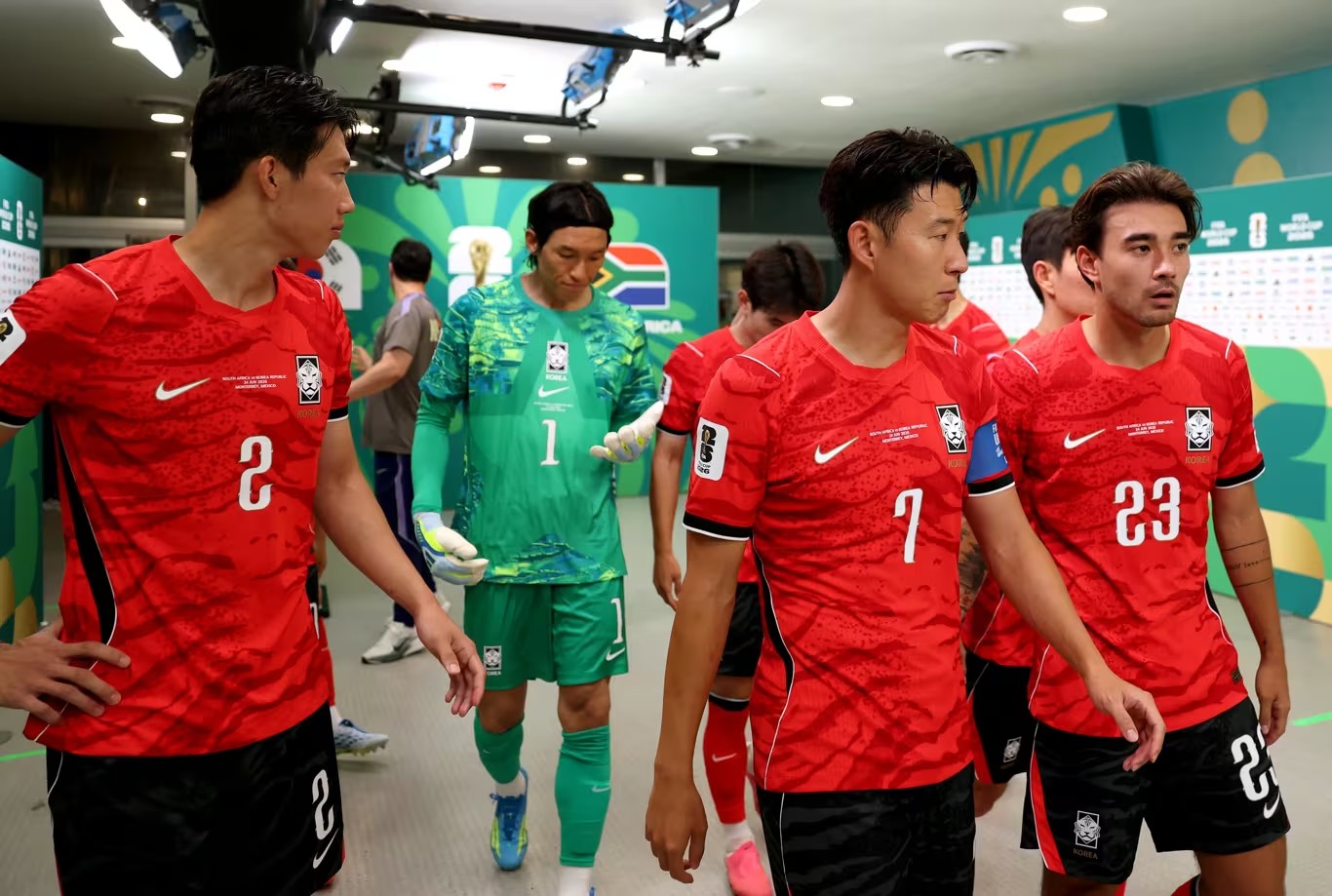
대한민국이 남아공에 0-1로 패하며 2026 FIFA 북중미 월드컵 조별리그 일정을 마쳤다. 홍명보 감독이 이끄는 한국 축구대표팀은 25일 한국시간 멕시코 과달루페의 몬테레이 스타디움에서 열린 A조 3차전에서 남아프리카공화국에 한 골 차로 졌다. 한국은 1승 2패, 승점 3으로 A조 3위에 머물렀고, 남아공은 1승 1무 1패, 승점 4로 조 2위를 차지하며 32강 진출을 확정했다.
이번 대한민국 대 남아공 경기는 단순한 조별리그 최종전이 아니었다. 한국에는 32강 자력 진출이 걸린 경기였고, 남아공에는 월드컵 역사상 첫 토너먼트 진출을 노리는 승부였다. 결과적으로 남아공은 제한된 기회를 살렸고, 한국은 점유율과 초반 흐름을 결과로 연결하지 못했다.
대한민국 선발 전략… 손흥민 벤치 카드 꺼낸 홍명보 감독
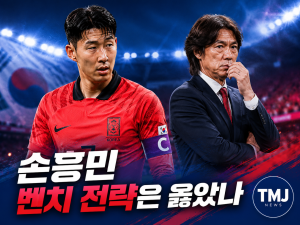
경기 전 가장 큰 관심은 손흥민의 선발 제외였다. 홍명보 감독은 손흥민을 벤치에서 출발시키고 후반 승부처에 투입하는 선택을 했다. 경기 후 홍 감독은 상대가 힘을 쓰는 전반보다 후반에 공간이 생겼을 때 손흥민을 활용하는 편이 낫다고 판단했다고 설명했다.
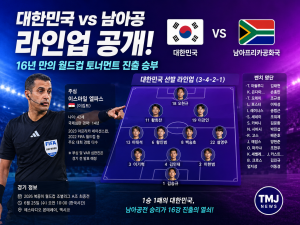
한국은 김민재를 중심으로 후방에서 빌드업을 시작했고, 황인범과 백승호가 중원에서 볼 순환을 맡았다. 전방에서는 이강인, 오현규, 황희찬이 공격을 구성했다. 기본 구조는 스리백 기반에 가까웠고, 공격 시에는 좌우 윙백이 높게 올라가며 측면 숫자를 늘리는 방식이었다. 수비 시에는 라인을 내려 공간을 관리하고, 공격 시에는 빠른 전환보다 안정적인 점유와 전진 패스를 통해 남아공 수비를 흔들려 했다.
남아공은 한국과 달리 공을 오래 소유하는 데 집착하지 않았다. 수비 시에는 미드블록을 형성해 중앙 공간을 막았고, 볼을 탈취하면 곧바로 전방의 빠른 선수들을 향해 연결했다. 남아공의 전략은 명확했다. 한국이 공을 잡게 하되, 위험 지역에서는 공간을 주지 않고, 빼앗은 뒤에는 빠르게 뒷공간을 노리는 방식이었다.
대한민국 대 남아공 전반전… 시작은 한국, 흐름은 남아공
전반 초반 한국은 적극적으로 경기를 시작했다. 전반 2분 김민재가 세트피스 상황에서 헤더를 시도했고, 이어 이강인이 페널티박스 안에서 왼발 슈팅으로 남아공 골문을 위협했다. 한국은 초반부터 볼을 소유하며 상대 진영에서 공격을 전개했고, 남아공은 낮은 위치에서 수비 간격을 유지했다.
그러나 시간이 흐르면서 경기 양상은 달라졌다. 한국은 점유율에서는 앞섰지만 페널티박스 안에서 결정적인 슈팅을 만드는 데 어려움을 겪었다. 하프스페이스를 활용한 침투와 마지막 패스의 완성도가 떨어졌고, 오현규를 향한 크로스와 침투 패스도 남아공 수비에 자주 차단됐다.
반면 남아공은 역습 상황에서 더 날카로웠다. 전반 중반 이후 남아공은 한국 수비 뒷공간을 노리며 공격 빈도를 높였다. 마세코와 마크고파 등 전방 자원들은 빠른 움직임으로 한국 수비 라인을 흔들었고, 한국은 김승규의 선방과 수비진의 마지막 태클로 위기를 넘겨야 했다.
전반전의 핵심은 분명했다. 한국은 공을 오래 잡았지만 남아공은 더 위협적인 공간을 노렸다. 국내 보도 역시 한국이 점유율에서는 앞섰지만 경기 주도권과 실질적 위협에서는 남아공의 역습이 더 날카로웠다고 평가했다.
후반 63분… 타펠로 마세코가 갈랐다
후반 들어 한국은 공격 템포를 높이려 했다. 홍명보 감독은 손흥민을 투입하며 흐름 변화를 노렸다. 손흥민은 좌우를 오가며 공격에 관여했고, 한국은 측면 크로스와 중앙 침투를 반복했다.
그러나 승부는 후반 63분 남아공의 한 번의 전환 공격에서 갈렸다. 남아공은 한국 진영에서 기회를 만들었고, 타펠로 마세코가 왼발 슈팅으로 골문 구석을 찔렀다. 이 골은 경기 전체의 구조를 압축한 장면이었다. 한국은 공을 더 오래 가졌지만, 남아공은 결정적인 순간에 더 빠르고 정확했다.
실점 이후 한국은 공격 숫자를 늘렸다. 조규성 등 공격 자원을 활용해 제공권과 박스 안 장악을 노렸고, 측면에서 크로스를 올리며 동점골을 시도했다. 그러나 남아공은 수비 라인을 낮추고 박스 안 밀집 수비를 강화했다. 한국의 패스는 자주 끊겼고, 크로스는 남아공 센터백과 골키퍼에게 막혔다.
경기 막판 한국은 총공세를 펼쳤지만 끝내 골문을 열지 못했다. 남아공은 마지막까지 수비 집중력을 유지했고, 1-0 승리를 지켜냈다.
국내 보도… 손흥민 벤치 전략과 결정력 부족에 초점
국내 언론은 이번 패배의 핵심을 크게 세 가지로 짚었다. 첫째는 손흥민 벤치 출발이다. 홍명보 감독의 선택은 전술적 승부수였지만, 결과적으로 한국이 전반부터 공격 리듬을 만들지 못하면서 논란이 커졌다. 손흥민은 후반 투입됐지만 이미 남아공 수비가 내려앉은 상황에서 공간을 찾기 어려웠다.
둘째는 결정력 부족이다. 한국은 초반 김민재의 헤더, 이강인의 슈팅 등 기회를 만들었지만 득점으로 연결하지 못했다. 월드컵 무대에서는 초반 기회를 살리지 못하면 경기 흐름이 상대에게 넘어갈 수 있다. 이번 경기가 그 사례였다.
셋째는 수비 전환 문제다. 한국은 공을 잃은 뒤 곧바로 압박을 걸거나 수비 대형을 회복해야 했지만, 남아공의 빠른 전환에 여러 차례 공간을 허용했다. 후반 63분 실점 역시 수비 전환과 공간 관리가 늦어진 장면에서 나왔다.
외신 평가… 한국은 점유했고, 남아공은 완성했다
외신은 남아공의 역사적 성과에 더 큰 비중을 뒀다. Reuters는 남아공이 한국을 1-0으로 꺾고 월드컵 사상 처음으로 토너먼트에 진출했다고 보도했다. 또 남아공이 네 번째 월드컵 도전 만에 조별리그를 통과했다는 점을 강조했다.
The Guardian도 남아공이 한국을 상대로 효율적인 경기 운영을 펼쳤다고 평가했다. 한국은 점유율을 가져갔지만 마지막 지역에서 창의성과 결정력이 부족했고, 남아공은 한 번의 기회를 결승골로 연결했다는 분석이다.
남아공의 위고 브로스 감독은 경기 후 선수들의 전술 수행 능력을 높게 평가했다. 그는 한국이 공간을 찾기 어렵게 만든 점, 득점 이후 버틴 수비 집중력을 승리 요인으로 봤다.
대한민국 축구가 남긴 과제
이번 대한민국 대 남아공 경기는 한국 축구에 분명한 숙제를 남겼다. 첫째, 점유율 축구의 완성도다. 공을 오래 소유하는 것만으로는 승리를 보장할 수 없다. 상대 박스 안에서 슈팅까지 이어지는 구조, 하프스페이스 침투, 세컨드볼 대응, 크로스 이후 마무리까지 연결돼야 한다.
둘째, 손흥민 활용 방식이다. 손흥민을 후반 조커로 쓰는 전략은 공간이 생긴다는 전제가 필요하다. 그러나 남아공처럼 선제골 이후 수비 라인을 낮추는 팀을 상대로는 오히려 공간이 줄어든다. 손흥민을 언제, 어디서, 누구와 함께 활용할 것인가는 앞으로도 대표팀의 핵심 전술 과제가 될 수밖에 없다.
셋째, 수비 전환이다. 월드컵에서는 한 번의 역습이 곧 실점으로 이어진다. 한국은 공격 전개 과정에서 공을 잃었을 때 즉시 압박과 커버 위치를 더 정교하게 가져가야 한다.
남아공에 의미 있는 역사적 승리
남아공에는 이번 승리가 역사적이다. 남아공은 이전 월드컵에서 조별리그를 넘지 못했지만, 이번에는 한국을 꺾고 처음으로 토너먼트 무대에 올랐다. 단순한 이변이 아니라, 전술적 준비와 수비 조직력, 빠른 전환 공격이 만든 성과였다.
남아공은 강한 압박과 속도를 앞세운 축구로 한국의 약점을 공략했다. 특히 마세코의 결승골은 남아공 축구가 가진 역동성과 효율성을 상징하는 장면이었다. 이번 승리는 남아공 축구가 국제무대에서 다시 존재감을 드러낸 순간으로 기록될 가능성이 크다.
한 경기 이상의 의미
대한민국과 남아공의 90분은 점유율과 결과가 반드시 일치하지 않는다는 사실을 다시 보여줬다. 한국은 공을 잡았지만 골을 넣지 못했고, 남아공은 기다렸고 기회를 살렸다. 월드컵은 결국 한 번의 집중력, 한 번의 전환, 한 번의 마무리가 승패를 가르는 무대다.
한국은 아직 3위 팀 간 순위에 따라 32강 가능성을 남겨두고 있지만, 자력 진출을 확정하지 못했다는 점에서 아쉬움이 크다. 이번 경기는 한국 축구가 다음 단계로 가기 위해 무엇을 보완해야 하는지를 분명히 보여준 경기였다.
편집자 주
더미디어저널리스트는 특정 정당·정치인·이념에 귀속되지 않습니다. 본 기사는 독자의 알 권리와 공익적 가치에 따라 작성됐으며, 사실과 맥락에 기반한 저널리즘을 지향합니다.
다음 기사 예고
대한민국이 남아공에 0-1로 패하며 드러난 전술적 과제와 손흥민 벤치 기용의 배경, 공격 완성도와 수비 전환 문제를 심층 분석한다.
South Korea Suffers 1-0 Shock Defeat to South Africa… Son Heung-min’s Second-Half Introduction Falls Short as Korea Misses Automatic Round of 32 Qualification
Hong Myung-bo’s side finishes third in Group A… South Africa reaches the World Cup knockout stage for the first time
Focus Keyword: South Korea South Africa
Meta Description: South Korea lost 1-0 to South Africa in the 2026 FIFA World Cup group stage. This report analyzes Son Heung-min’s second-half introduction, Hong Myung-bo’s tactics, domestic and foreign media reactions, and the challenges facing Korean football.
South Korea ended its 2026 FIFA World Cup group-stage campaign with a 1-0 defeat to South Africa. Hong Myung-bo’s side lost by a single goal in their third Group A match at Estadio Monterrey in Guadalupe, Mexico, on June 25, Korea time. South Korea finished third in Group A with one win and two losses, collecting three points. South Africa finished second with one win, one draw and one loss, securing four points and a place in the Round of 32.
The South Korea-South Africa match was more than a final group-stage fixture. For South Korea, it was a game tied to automatic qualification. For South Africa, it was a chance to reach the World Cup knockout stage for the first time in its history. In the end, South Africa made the most of its limited opportunities, while South Korea failed to turn possession and early momentum into goals.
South Korea’s starting strategy… Hong Myung-bo keeps Son Heung-min on the bench
The biggest talking point before kickoff was Son Heung-min’s absence from the starting lineup. Hong Myung-bo chose to begin the match with Son on the bench and use him as a second-half weapon. After the game, Hong explained that he believed Son would be more effective once spaces opened up after South Africa had spent energy in the first half.
South Korea built from the back around Kim Min-jae, while Hwang In-beom and Paik Seung-ho were tasked with circulating the ball in midfield. In attack, Lee Kang-in, Oh Hyeon-gyu and Hwang Hee-chan formed the front line. The structure was closer to a back-three system, with the wing-backs pushing high in possession to create width. Defensively, Korea aimed to maintain balance, while in attack it relied on controlled possession and forward passing rather than rapid transitions.
South Africa took a different approach. The team did not seek long spells of possession. Instead, it formed a compact mid-block, closed central spaces and looked to release its quick attackers immediately after winning the ball. The plan was clear: allow Korea to have the ball, deny dangerous spaces and attack quickly behind the defensive line.
First half… Korea started well, but South Africa grew into the game
South Korea began the match aggressively. In the second minute, Kim Min-jae attempted a header from a set-piece situation. Lee Kang-in soon followed with a left-footed shot inside the penalty area, testing the South African defense. Korea controlled possession early and tried to build attacks in the South African half, while South Africa defended deep and kept its shape.
As the half progressed, however, the flow began to change. Korea had more of the ball but struggled to create clear chances inside the penalty area. The team failed to consistently exploit the half-spaces, and the final pass often lacked precision. Crosses and through balls toward Oh Hyeon-gyu were repeatedly blocked by South Africa’s defenders.
South Africa, by contrast, looked sharper in transition. From midway through the first half, South Africa began to target the space behind Korea’s defensive line more frequently. Thapelo Maseko and Evidence Makgopa used their movement and pace to stretch Korea’s back line, forcing goalkeeper Kim Seung-gyu and the defenders into several important interventions.
The meaning of the first half was clear. Korea had more possession, but South Africa attacked the more dangerous spaces. Korean coverage also pointed out that while Korea appeared to have control, South Africa’s counterattacks carried the greater threat.
The 63rd minute… Thapelo Maseko decides the match
South Korea tried to raise the tempo in the second half. Hong Myung-bo introduced Son Heung-min in an attempt to change the rhythm. Son moved across the front line and became involved in Korea’s attacks, while the team continued to look for openings through wide crosses and central runs.
But the match was decided in the 63rd minute by one South African transition. South Africa created a chance in Korea’s half, and Thapelo Maseko finished with a left-footed strike into the corner. The goal summed up the structure of the match. Korea had more of the ball, but South Africa was faster and more precise when it mattered most.
After conceding, Korea increased its attacking numbers. Cho Gue-sung and other attacking options were used to strengthen Korea’s aerial presence and penalty-area threat. Korea continued to send crosses into the box, but South Africa dropped deeper, compressed the space and defended with discipline. Korea’s passes were often interrupted, and its crosses were handled by South Africa’s center-backs and goalkeeper.
Korea pushed until the final whistle, but it could not find an equalizer. South Africa maintained its defensive concentration and protected the 1-0 lead.
Korean media reaction… Son bench decision and finishing problems under scrutiny
Korean media focused on three major factors behind the defeat.
The first was Son Heung-min’s bench role. Hong Myung-bo’s decision was intended as a tactical move, but it became controversial after Korea failed to establish an attacking rhythm from the start. When Son entered in the second half, South Africa had already settled deeper defensively, leaving him with less space to exploit.
The second issue was finishing. Korea created early moments through Kim Min-jae’s header and Lee Kang-in’s shot, but failed to convert them. At the World Cup, missing early chances can shift the momentum. This match became a clear example.
The third issue was defensive transition. When Korea lost the ball, it needed to either press immediately or recover its defensive shape quickly. Instead, South Africa repeatedly found space in transition. The 63rd-minute goal also came from a moment in which Korea’s defensive recovery and space management were not sharp enough.
Foreign media reaction… Korea possessed, South Africa finished
Foreign media placed greater emphasis on South Africa’s historic achievement. Reuters reported that South Africa defeated South Korea 1-0 to reach the World Cup knockout stage for the first time. It also highlighted that South Africa had finally advanced from the group stage in its fourth World Cup appearance.
The Guardian also noted South Africa’s efficient game management. Korea had more possession, but lacked creativity and finishing quality in the final third. South Africa, meanwhile, turned one decisive opportunity into the winning goal.
South Africa head coach Hugo Broos praised his players’ tactical discipline after the match. He pointed to the team’s ability to deny Korea space and maintain defensive concentration after scoring as key factors in the win.
What the match means for South Korean football
The South Korea-South Africa match leaves clear questions for Korean football. The first is the quality of possession-based football. Having more of the ball does not guarantee victory. Possession must lead to penetration, shots, second-ball control and finishing inside the box.
The second issue is how to use Son Heung-min. Deploying Son as a second-half impact substitute depends on the assumption that space will open up. Against a team like South Africa, however, once the opponent scores first and drops deeper, those spaces become even smaller. How, when and with whom Korea uses Son will remain a central tactical question.
The third issue is defensive transition. At the World Cup, one counterattack can become one goal. Korea must refine its immediate pressing, cover positioning and defensive recovery when possession is lost.
A historic victory for South Africa
For South Africa, this was a historic win. The team had never gone beyond the group stage in previous World Cup appearances, but this time it defeated South Korea and reached the knockout stage for the first time.
It was not simply an upset. It was the result of tactical preparation, defensive organization and quick transition play. South Africa exposed Korea’s weaknesses with speed and discipline. Maseko’s winning goal symbolized the energy and efficiency of South African football.
This victory may be remembered as the moment South Africa reasserted its presence on the international stage.
More than one match
The 90 minutes between South Korea and South Africa showed once again that possession and results do not always move together. Korea had the ball but failed to score. South Africa waited, defended and took its chance.
The World Cup is a stage where one moment of concentration, one transition and one finish can decide everything.
Korea still has a possible path depending on the ranking of third-placed teams, but failing to secure automatic qualification leaves deep frustration. This match clearly showed what Korean football must improve to move to the next level.
Editor’s Note
The Media Journalist is not affiliated with any political party, politician or ideology. This article was written in the public interest and for the reader’s right to know, based on facts, context and responsible journalism.
Next Article Preview
② What Hong Myung-bo’s Side Must Fix… Was the Son Heung-min Bench Strategy the Right Decision?
The next article will analyze the tactical issues exposed in South Korea’s 1-0 defeat to South Africa, including the background of Son Heung-min’s bench role, Korea’s attacking limitations and defensive transition problems.
📌 시리즈 함께 읽기
① 대한민국, 남아공에 0-1 충격패… 손흥민 후반 투입도 역부족, 32강 자력 진출 무산 — 지금 읽는 글
② 홍명보호가 남긴 과제… 대한민국 남아공전, 손흥민 벤치 전략은 옳았나 — 심층 전술 분석
저작권자 © '더미디어저널리스트' 무단전재 및 재배포, AI학습 및 활용 금지
작성자 소개