남아공전 0-1 패배가 드러낸 한국 축구의 전술적 한계
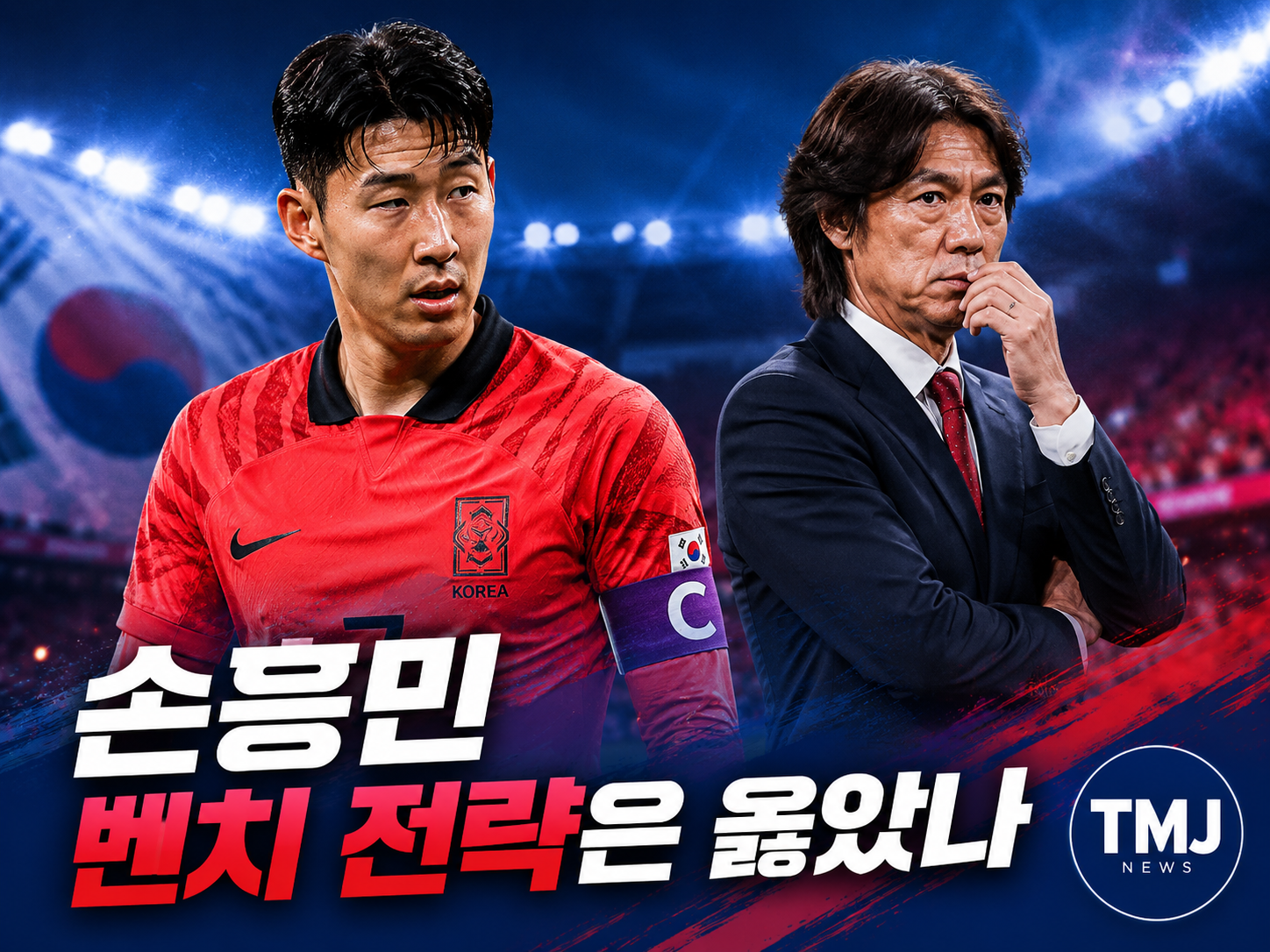
대한민국 남아공전 0-1 패배는 단순한 조별리그 최종전 패배가 아니었다. 홍명보호는 2026 FIFA 북중미 월드컵 A조 최종전에서 남아프리카공화국에 한 골 차로 패했고, 한국 축구는 32강 진출을 자력으로 확정하지 못한 채 다른 조 3위 팀들의 결과를 지켜봐야 하는 상황에 놓였다. 홍명보 감독의 손흥민 벤치 전략은 이 경기에서 가장 큰 논란이 되었다.
경기 후 가장 큰 논쟁은 손흥민 벤치 전략이었다. 홍명보 감독은 손흥민을 선발에서 제외하고 후반 시작과 함께 투입했다. 손흥민을 후반 공간 활용 카드로 쓰겠다는 판단이었다. 하지만 남아공은 후반에도 수비 간격을 유지했고, 후반 63분 타펠로 마세코의 결승골 이후에는 더 낮은 수비 블록으로 한국의 공격 공간을 줄였다.
결과적으로 손흥민 벤치 전략은 기대한 효과를 내지 못했다. 대한민국 남아공전은 한국 축구가 점유율, 빌드업, 공격 완성도, 수비 전환에서 어떤 과제를 안고 있는지를 분명히 보여준 경기였다.
※ 이 글은 ① 대한민국, 남아공에 0-1 충격패… 손흥민 후반 투입도 역부족, 32강 자력 진출 무산의 후속 심층 분석입니다.
손흥민 벤치 전략은 왜 나왔나
손흥민은 한국 축구의 상징이자 대표팀 공격의 중심이다. 그런 선수를 월드컵 조별리그 최종전에서 벤치에 둔 것은 단순한 체력 안배가 아니라 전술적 선택이었다.
홍명보 감독은 경기 후 손흥민 기용에 대해 “상대가 힘이 있는 전반보다 45분을 마치고 공간이 좀 생겼을 때 넣는 게 좋다고 판단했다”는 취지로 설명했다. 이 발언의 핵심은 분명하다. 전반에는 활동량과 압박 강도를 앞세우고, 후반에는 손흥민의 침투와 결정력을 활용하겠다는 구상이었다.
축구적으로 이 선택이 완전히 이해되지 않는 것은 아니다. 손흥민은 넓은 공간에서 가장 위협적인 선수다. 수비 라인 뒤로 침투하는 움직임, 빠른 전환 상황에서의 스프린트, 양발 마무리 능력은 여전히 한국 대표팀의 가장 강력한 무기다.
문제는 손흥민 벤치 전략이 성공하려면 경기 조건이 따라와야 한다는 점이다. 한국이 전반을 0-0으로 안정적으로 버티거나, 남아공을 계속 앞으로 끌어내야 손흥민이 활용할 공간이 생긴다. 그러나 대한민국 남아공전은 그렇게 흘러가지 않았다. 한국은 득점하지 못했고, 남아공은 버틴 뒤 한 번의 기회를 살렸다.
대한민국 남아공전 전반전, 점유율은 있었지만 결정력은 없었다
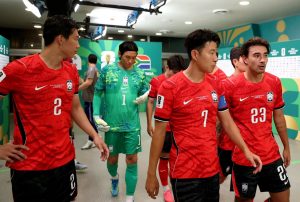
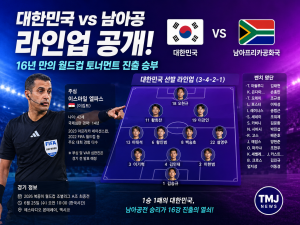
대한민국은 경기 초반부터 볼을 소유하며 남아공 진영에서 공격을 전개했다. 김민재를 중심으로 후방 빌드업을 시작했고, 황인범과 백승호가 중원에서 볼 순환을 담당했다. 이강인, 오현규, 황희찬은 전방에서 공격 조합을 구성했다.
한국의 기본 구조는 스리백 기반 운영에 가까웠다. 공격 시 좌우 측면 자원이 높게 올라가 폭을 만들었고, 중원에서는 짧은 패스를 통해 경기 템포를 조절했다. 전술적으로는 안정적인 빌드업과 측면 전개를 통해 남아공 수비 블록을 흔드는 것이 목표였다.
그러나 전반전의 문제는 명확했다. 한국은 공을 오래 소유했지만, 남아공 페널티박스 안에서 결정적인 장면을 충분히 만들지 못했다. 하프스페이스 공략은 제한적이었고, 마지막 패스와 슈팅의 정확도도 부족했다.
남아공은 공을 오래 갖는 데 집착하지 않았다. 대신 미드블록을 유지하며 중앙 공간을 닫았고, 한국의 공격을 측면으로 유도했다. 한국이 측면으로 공을 돌리면 남아공은 수비 간격을 좁혔고, 중앙 침투를 시도하면 미드필더들이 공간을 차단했다.
결국 대한민국 남아공전 전반전은 “점유율은 한국, 실질적 위협은 제한적”이라는 말로 요약된다. 공을 가진 시간이 길었다고 해서 경기를 완전히 지배한 것은 아니었다. 월드컵 무대에서는 점유율보다 박스 안 완성도가 더 중요하다.
한국의 3백 운영, 안정적이었지만 날카롭지 않았다
홍명보호는 남아공전에서 수비 안정과 후방 빌드업을 동시에 고려한 구조를 선택했다. 김민재를 중심으로 한 수비 라인은 후방에서 공을 전개했고, 측면 자원들은 공격 시 높게 올라가 폭을 만들었다.
이 구조는 일정 부분 안정적이었다. 한국은 무리한 롱볼보다 짧은 패스를 통해 경기를 풀어가려 했고, 중원에서 볼을 돌리며 상대 수비를 끌어내려 했다. 그러나 안정적인 빌드업이 곧 날카로운 공격을 의미하지는 않는다.
한국의 공격은 시간이 갈수록 예측 가능해졌다. 남아공은 중앙을 막고 한국을 바깥으로 몰아냈다. 한국은 측면 크로스와 중앙 침투를 반복했지만 박스 안에서 수적 우위를 만들지 못했다. 오현규는 전방에서 버티려 했고, 황희찬은 속도를 살리려 했지만 공간은 충분하지 않았다.
특히 하프스페이스 활용이 아쉬웠다. 하프스페이스는 중앙과 측면 사이의 공간으로, 현대 축구에서 밀집 수비를 깨는 핵심 구역이다. 이강인 같은 창의적인 선수가 있어도, 그 공간으로 침투하는 움직임과 패스를 받을 타이밍이 맞지 않으면 공격은 살아나기 어렵다.
대한민국 남아공전에서 한국은 공을 전진시키는 데는 성공했지만, 상대 수비 라인을 무너뜨리는 데는 실패했다. 이것이 홍명보호가 남긴 첫 번째 과제다.
후반 시작 손흥민 투입, 그러나 공간은 열리지 않았다
홍명보 감독은 후반 시작과 함께 손흥민을 투입했다. 손흥민 벤치 전략의 본격적인 실행이었다. 한국은 손흥민을 통해 공격의 속도와 마무리 능력을 끌어올리려 했다.
그러나 손흥민이 들어왔을 때 경기의 조건은 기대만큼 좋지 않았다. 남아공은 후반에도 수비 간격을 유지했다. 한국이 원하는 만큼 라인을 올리지 않았고, 손흥민이 뒷공간을 향해 속도를 낼 장면도 많지 않았다.
손흥민은 좌우를 오가며 공을 받으려 했다. 하지만 남아공 수비는 손흥민이 앞을 보고 달릴 공간을 허용하지 않았다. 손흥민이 가장 위협적인 장면은 넓은 공간에서 수비 라인 뒤를 파고드는 순간이다. 이날 남아공은 그 공간을 쉽게 내주지 않았다.
손흥민 투입 이후 한국은 공격 숫자를 늘렸지만, 공격 방식은 여전히 측면 크로스와 중앙 밀집 공격에 의존하는 흐름이 많았다. 손흥민 개인의 능력만으로 이미 좁아진 수비 블록을 무너뜨리기에는 구조적 지원이 부족했다.
따라서 손흥민 벤치 전략의 실패를 손흥민 개인의 문제로 볼 수는 없다. 문제는 손흥민이 들어왔을 때 그 장점을 살릴 수 있는 경기 환경과 공격 구조가 충분히 만들어지지 않았다는 점이다.
후반 63분 실점, 수비 전환의 약점이 드러났다
대한민국 남아공전의 승부는 후반 63분 갈렸다. 남아공은 한국 진영에서 기회를 만들었고, 타펠로 마세코가 왼발 슈팅으로 결승골을 기록했다.
이 장면은 남아공의 장점과 한국의 약점이 동시에 드러난 순간이었다. 남아공은 전환이 빨랐다. 공을 잡은 뒤 망설이지 않고 전방으로 연결했고, 한국 수비가 완전히 정돈되기 전 공간을 공략했다.
반면 한국은 공을 잃은 뒤 첫 압박과 후방 커버가 동시에 작동하지 않았다. 수비 숫자가 완전히 부족했다기보다, 위치와 타이밍이 흔들렸다. 현대 축구에서 전환은 경기의 심장부다. 공격에서 수비로, 수비에서 공격으로 바뀌는 몇 초가 승패를 결정한다.
월드컵에서는 한 번의 전환 실패가 곧 실점이 된다. 남아공전 실점은 그 사실을 다시 보여줬다. 한국은 점유율을 가져갔지만, 공을 잃은 뒤 위험 관리에서는 충분히 정교하지 못했다.
점유율 축구의 함정
한국은 공을 많이 소유했다. 하지만 점유율은 결과가 아니라 수단이다. 공을 오래 갖고 있어도 상대 박스 안에서 슈팅을 만들지 못하면 경기 지배력은 반쪽짜리에 그친다.
대한민국 남아공전에서 한국은 공을 돌렸지만, 남아공 수비를 무너뜨릴 만큼 빠르거나 날카롭지 않았다. 패스는 이어졌지만 전진성이 부족했고, 공격 전개는 반복됐지만 변칙성이 부족했다.
남아공은 한국의 공격 방향을 읽었다. 한국이 측면으로 공을 보내면 측면 수비를 압축했고, 한국이 중앙으로 들어오려 하면 중원에서 공간을 막았다. 한국은 플랜A를 반복했지만, 플랜B는 뚜렷하지 않았다.
이 경기는 한국 축구가 점유율 축구를 말할 때 반드시 함께 고민해야 할 질문을 남겼다. 공을 얼마나 오래 갖고 있었는가가 아니라, 그 공으로 어디까지 들어갔는가. 몇 번의 패스를 했는가가 아니라, 몇 번의 결정적 장면을 만들었는가.
김승규와 수비진의 대응, 그러나 구조는 흔들렸다
한국은 경기 중 몇 차례 위기에서 김승규와 수비진의 대응으로 추가 실점을 막았다. 골키퍼의 집중력과 수비진의 마지막 대응은 분명 긍정적인 장면이었다.
그러나 수비는 개인이 아니라 구조다. 공을 잃은 직후 누가 압박하고, 누가 뒤를 커버하며, 측면에서 중앙으로 들어오는 선수를 누가 따라갈 것인지가 명확해야 한다.
남아공전에서 한국은 이 구조가 흔들리는 순간을 노출했다. 김민재가 수비 중심을 잡고 김승규가 마지막 방어선을 지켰지만, 팀 전체의 전환 속도가 늦어지는 순간 실점이 나왔다.
이는 특정 선수 한 명의 책임이라기보다 팀 단위 수비 전환의 문제로 봐야 한다. 홍명보호가 다음 경기를 준비한다면, 공격 전개 못지않게 공을 잃은 직후의 수비 구조를 정비해야 한다.
홍명보 감독의 책임론
홍명보 감독은 경기 후 패배의 책임을 자신에게 돌렸다. 감독으로서 결과를 받아들이겠다는 의미다. 동시에 손흥민 벤치 전략과 경기 운영이 결과적으로 효과를 내지 못했다는 사실을 인정한 발언으로 읽힌다.
감독의 전술은 의도가 아니라 결과로 평가받는다. 손흥민을 벤치에 둔 선택, 전반 공격 조합, 후반 시작과 함께 손흥민을 투입한 판단, 실점 이후 공격 방식은 모두 감독의 영역이다.
물론 손흥민 벤치 전략의 의도 자체를 무조건 틀렸다고 말할 수는 없다. 후반 공간 활용은 축구적으로 가능한 접근이다. 그러나 그 전략이 작동하려면 전반 운영, 수비 안정, 득점 가능성, 후반 경기 조건이 함께 맞아야 한다. 남아공전에서는 그 조건이 만들어지지 않았다.
따라서 홍명보호의 문제는 단순히 “손흥민을 왜 선발로 쓰지 않았나”에 그치지 않는다. 더 근본적인 질문은 이것이다. 손흥민을 벤치에 둘 만큼 전반 공격 구조가 충분히 강했는가. 손흥민이 들어왔을 때 그 장점을 살릴 구조가 준비돼 있었는가.
선수 개인보다 구조의 문제
패배 이후 특정 선수에게 책임을 돌리는 것은 쉽다. 그러나 대한민국 남아공전의 문제는 한두 명의 실수만으로 설명되지 않는다. 더 큰 문제는 구조였다.
이강인은 창의적인 패스를 시도했지만 주변 움직임이 충분히 맞물리지 않았다. 황희찬은 속도를 살리려 했지만 공간이 좁았다. 오현규는 전방에서 버티려 했지만 박스 안 지원이 늦었다. 손흥민은 후반 시작과 함께 들어왔지만 활용할 공간이 많지 않았다.
수비도 마찬가지다. 김민재가 중심을 잡고 김승규가 대응했지만, 팀 전체의 수비 전환 속도가 늦어지는 순간 실점이 나왔다. 축구는 개인 능력의 합이 아니라 구조의 결과다.
남아공전은 한국의 개인 능력이 부족했다기보다, 그 능력을 연결하는 구조가 충분히 작동하지 않은 경기였다.
한국 축구가 보완해야 할 다섯 가지
첫째, 공격 패턴의 다양성이다. 측면 크로스와 중앙 침투만으로는 밀집 수비를 깨기 어렵다. 중거리 슈팅, 컷백, 2선 침투, 세컨드볼 장악 등 다양한 공격 루트가 필요하다.
둘째, 하프스페이스 활용이다. 이강인 같은 창의적인 자원이 있다면 그 주변에서 움직이는 선수들의 침투 타이밍이 더 정교해야 한다. 패스를 넣을 선수만 있어서는 안 된다. 받을 선수가 움직여야 한다.
셋째, 손흥민 활용법이다. 손흥민은 여전히 한국 최고의 공격 자원이다. 그러나 손흥민을 후반 조커로 쓸 것인지, 선발로 두고 경기 초반부터 상대 수비를 흔들게 할 것인지는 더 깊은 논의가 필요하다.
넷째, 수비 전환이다. 공을 잃은 직후 첫 압박과 후방 커버가 동시에 작동해야 한다. 남아공전 실점은 이 부분의 중요성을 다시 보여줬다.
다섯째, 경기 관리 능력이다. 월드컵에서는 승리해야 할 경기와 지지 않아야 할 경기의 운영 방식이 달라야 한다. 한국은 점유율을 가져갔지만 경기 리스크를 완전히 통제하지 못했다. 이 부분은 홍명보호가 반드시 보완해야 할 과제다.
손흥민 벤치 전략은 옳았나
질문은 다시 처음으로 돌아온다. 손흥민 벤치 전략은 옳았나.
전술적 의도만 보면 이해할 수 없는 선택은 아니었다. 후반 공간을 노린다는 구상은 축구적으로 가능하다. 그러나 결과적으로는 효과를 내지 못했다. 남아공은 한국이 원하는 만큼 공간을 내주지 않았고, 선제골 이후에는 더 내려앉아 손흥민이 활용할 공간을 줄였다.
손흥민을 벤치에 둔 전략이 성공하려면 한국은 전반에 더 강하게 남아공을 흔들었어야 했다. 최소한 득점에 가까운 장면을 여러 차례 만들었어야 했다. 그러나 한국은 전반부터 공격 리듬을 완전히 잡지 못했다.
손흥민이 들어왔을 때는 이미 경기 조건이 불리하게 바뀌어 있었다. 따라서 손흥민 벤치 전략은 의도는 있었지만, 경기 흐름을 통제하지 못한 승부수였다고 평가할 수 있다.
남아공전은 끝났지만 질문은 남았다
대한민국 남아공전은 끝났다. 그러나 질문은 남았다.
한국 축구는 점유율을 어떻게 득점으로 바꿀 것인가. 손흥민을 어떤 방식으로 활용할 것인가. 월드컵 무대에서 한 번의 역습을 어떻게 막을 것인가. 비겨도 되는 흐름, 버텨야 하는 흐름, 승부를 걸어야 하는 흐름을 어떻게 구분할 것인가.
이번 패배는 아프다. 그러나 아픈 경기일수록 더 정확히 복기해야 한다. 감정적 비난보다 필요한 것은 구조적 분석이다. 그래야 같은 장면이 반복되지 않는다.
홍명보호는 남아공전에서 답을 얻지 못했다. 대신 과제를 받았다. 그 과제를 풀지 못하면 다음 월드컵에서도 같은 질문 앞에 서게 될 것이다.
편집자 주
본 기사는 국내외 보도와 확인 가능한 경기 기록을 바탕으로 작성한 전술 분석 기사입니다. 특정 선수 개인에 대한 비난이 아니라 경기 운영, 전술 구조, 대표팀의 향후 과제를 분석하는 데 목적이 있습니다.
📌 시리즈 함께 읽기
① 대한민국, 남아공에 0-1 충격패… 손흥민 후반 투입도 역부족, 32강 자력 진출 무산 — 경기 전체 종합 분석
② 홍명보호가 남긴 과제… 대한민국 남아공전, 손흥민 벤치 전략은 옳았나 — 지금 읽는 글
② The Tasks Hong Myung-bo’s Team Left Behind: Was the Decision to Bench Son Heung-min Against South Africa Right?
South Korea’s 0-1 defeat to South Africa exposed the tactical limits of Korean football
South Korea’s 0-1 defeat to South Africa was not merely a loss in the final group-stage match. Hong Myung-bo’s side fell by one goal to South Africa in their final Group A match at the 2026 FIFA World Cup, leaving Korea unable to secure direct qualification for the Round of 32 and forced to wait for the results of other third-placed teams. The decision to leave Son Heung-min on the bench became the biggest controversy of the match.
After the game, the most debated issue was the strategy of starting Son Heung-min on the bench. Hong excluded Son from the starting lineup and brought him on at the beginning of the second half. The plan appeared to be to use Son as a weapon against spaces that might open up later in the match. However, South Africa maintained its defensive spacing even after halftime. After Thapelo Maseko scored the decisive goal in the 63rd minute, South Africa dropped into an even lower defensive block and further reduced Korea’s attacking space.
In the end, the bench strategy involving Son Heung-min failed to produce the expected effect. The South Korea-South Africa match clearly revealed the tasks Korean football still faces in terms of possession, build-up play, attacking precision and defensive transition.
※ This article is a follow-up tactical analysis to Part ①, “South Korea Suffers 0-1 Shock Defeat to South Africa… Son Heung-min’s Second-Half Appearance Not Enough as Direct Qualification to Round of 32 Slips Away.”
Why did the Son Heung-min bench strategy emerge?
Son Heung-min is the symbol of Korean football and the focal point of the national team’s attack. Leaving such a player on the bench in the final group-stage match of the World Cup was not simply about managing his fitness. It was a tactical choice.
After the match, Hong Myung-bo explained his decision by saying, in effect, that he believed it would be better to bring Son on after the first 45 minutes, when space might begin to appear rather than during the first half when the opponent still had strength. The meaning of the statement was clear. Korea would rely on intensity and pressing in the first half, then use Son’s runs and finishing ability in the second half.
From a footballing perspective, the decision was not entirely unreasonable. Son remains most dangerous in open space. His ability to run behind defensive lines, sprint in transition and finish with both feet is still Korea’s most powerful attacking weapon.
The problem is that such a strategy requires certain match conditions to work. Korea either had to keep the score stable at 0-0 in the first half or continuously draw South Africa forward to create space for Son. But the South Korea-South Africa match did not unfold that way. Korea failed to score, while South Africa held firm and took advantage of one decisive opportunity.
South Korea’s first half: possession without decisive finishing
South Korea controlled the ball from the early stages and built attacks in South Africa’s half. Kim Min-jae initiated the build-up from the back, while Hwang In-beom and Paik Seung-ho circulated possession in midfield. Lee Kang-in, Oh Hyeon-gyu and Hwang Hee-chan formed the attacking unit.
Korea’s basic structure was close to a back-three system. In attack, the wide players pushed high to provide width, while midfielders controlled the tempo through short passing. Tactically, the goal was to destabilize South Africa’s defensive block through stable build-up play and wide progression.
But the problem in the first half was clear. Korea held the ball for long spells but failed to create enough decisive moments inside the South African penalty area. The use of half-spaces was limited, while the accuracy of final passes and shots was insufficient.
South Africa did not obsess over possession. Instead, it maintained a mid-block, closed central spaces and guided Korea’s attacks toward the flanks. When Korea moved the ball wide, South Africa narrowed its defensive spacing. When Korea tried to attack centrally, South African midfielders blocked the channels.
In the end, the first half of the South Korea-South Africa match can be summarized as follows: possession belonged to Korea, but real threat was limited. Having more of the ball did not mean Korea fully controlled the match. On the World Cup stage, precision inside the penalty area matters more than possession itself.
Korea’s back-three system was stable, but not sharp
Hong Myung-bo’s side chose a structure that considered both defensive stability and build-up from the back. The defensive line, centered on Kim Min-jae, circulated the ball from deep, while the wide players advanced high in attack to create width.
This structure was stable to a certain extent. Korea tried to solve the game through short passing rather than risky long balls, circulating possession in midfield to draw out the opposition defense. But stable build-up does not automatically mean sharp attacking play.
Korea’s attacks became increasingly predictable as the match went on. South Africa blocked the center and pushed Korea toward the outside. Korea repeatedly attempted crosses from wide areas and central penetrations, but failed to create numerical superiority inside the box. Oh Hyeon-gyu tried to hold the ball up in the front line, and Hwang Hee-chan attempted to use his pace, but there was not enough space.
The lack of half-space usage was particularly disappointing. The half-space, the zone between the center and the flank, is a key area for breaking down compact defenses in modern football. Even with a creative player like Lee Kang-in, attacks cannot come alive if the timing of supporting runs and receiving movements does not match.
In the South Korea-South Africa match, Korea succeeded in moving the ball forward but failed to break the opponent’s defensive line. That is the first task Hong Myung-bo’s team has left behind.
Son Heung-min came on at halftime, but the space never opened
Hong Myung-bo introduced Son Heung-min at the start of the second half. This was the point at which the bench strategy was put into action. Korea tried to increase the pace and finishing quality of its attack through Son.
However, when Son entered the match, the conditions were not as favorable as expected. South Africa maintained its defensive spacing even after halftime. It did not push its line as high as Korea might have hoped, and there were few opportunities for Son to sprint into the space behind the defense.
Son moved across the front line, trying to receive the ball from both sides. But South Africa did not allow him the space to face forward and accelerate. Son is at his most dangerous when he can attack open space behind the defensive line. On this day, South Africa did not easily offer him that space.
After Son came on, Korea increased its attacking numbers, but the attacking pattern still relied heavily on wide crosses and congested central attacks. There was not enough structural support for Son’s individual ability to break down an already compact defensive block.
Therefore, the failure of the Son Heung-min bench strategy should not be seen as Son’s personal problem. The issue was that the match environment and attacking structure were not sufficiently prepared to maximize his strengths when he came on.
The 63rd-minute goal exposed Korea’s weakness in defensive transition
The decisive moment of the South Korea-South Africa match came in the 63rd minute. South Africa created an opportunity in Korea’s half, and Thapelo Maseko scored the winning goal with a left-footed shot.
The scene showed both South Africa’s strength and Korea’s weakness at the same time. South Africa transitioned quickly. Once it won the ball, it moved forward without hesitation and attacked the space before Korea’s defense had fully reorganized.
By contrast, Korea’s first press and defensive cover did not operate together after losing possession. The issue was not simply a lack of defensive numbers. It was a problem of positioning and timing. In modern football, transition is the heart of the game. The few seconds when attack turns into defense, or defense turns into attack, often decide the result.
At the World Cup, one failed transition can immediately become a goal conceded. The goal against South Africa reminded Korea of that reality. Korea had possession, but its risk management after losing the ball was not precise enough.
The trap of possession football
Korea had a lot of the ball. But possession is not the result. It is only a tool. No matter how long a team keeps possession, if it cannot create shots inside the opponent’s box, its control of the game remains incomplete.
Against South Africa, Korea circulated the ball but was neither fast nor sharp enough to break down the defensive structure. Passes were connected, but lacked forward penetration. Attacks were repeated, but lacked unpredictability.
South Africa read Korea’s attacking direction. When Korea sent the ball wide, South Africa compressed the flank. When Korea tried to move centrally, South Africa blocked the midfield space. Korea repeated Plan A, but there was no clear Plan B.
This match left Korean football with an important question about possession football. The question is not how long the team keeps the ball. It is how far that possession carries the team into dangerous areas. The question is not how many passes are completed. It is how many decisive chances are created.
Kim Seung-gyu and the defense responded, but the structure was shaken
During the match, Korea avoided further goals thanks to several interventions from Kim Seung-gyu and the defensive line. The goalkeeper’s concentration and the defense’s last-ditch responses were certainly positive moments.
But defense is not only about individuals. It is about structure. After losing possession, it must be clear who presses first, who provides cover behind, and who tracks runners moving from wide areas into the center.
Against South Africa, Korea exposed moments when that structure became unstable. Kim Min-jae held the defensive center and Kim Seung-gyu protected the last line, but when the team’s overall transition speed slowed, the goal came.
This should be seen less as the responsibility of one particular player and more as a team-wide issue in defensive transition. If Hong Myung-bo’s side is to prepare for the next match, it must refine the defensive structure immediately after losing possession, just as much as it works on attacking build-up.
The question of Hong Myung-bo’s responsibility
After the match, Hong Myung-bo accepted responsibility for the defeat. As head coach, it meant he was willing to bear the result. At the same time, the statement can also be read as an acknowledgement that the bench strategy involving Son Heung-min and the overall match management did not produce the intended effect.
A manager’s tactics are judged not by intention, but by outcome. The decision to leave Son on the bench, the first-half attacking combination, the halftime substitution and the attacking approach after conceding all belong to the manager’s area of responsibility.
Of course, the intention behind benching Son cannot be described as entirely wrong. Using him to exploit second-half space was a possible footballing approach. But for that strategy to work, the first-half management, defensive stability, scoring potential and second-half match conditions all had to align. Against South Africa, those conditions were not created.
Therefore, the issue with Hong Myung-bo’s team is not simply, “Why did Son Heung-min not start?” The deeper questions are these: Was the first-half attacking structure strong enough to justify leaving Son on the bench? And when Son entered the match, was the structure ready to maximize his strengths?
A structural problem, not an individual one
After a defeat, it is easy to blame specific players. But the problems in the South Korea-South Africa match cannot be explained by one or two individual mistakes. The larger issue was structural.
Lee Kang-in attempted creative passes, but the surrounding movements did not connect sufficiently. Hwang Hee-chan tried to use his pace, but the space was too narrow. Oh Hyeon-gyu tried to hold the ball up front, but support inside the box arrived late. Son Heung-min came on at the beginning of the second half, but there was not much space for him to use.
The same applies to the defense. Kim Min-jae held the center and Kim Seung-gyu responded in goal, but when the team’s defensive transition slowed, the goal arrived. Football is not merely the sum of individual abilities. It is the result of structure.
The South Africa match was not so much a game in which Korea lacked individual talent. Rather, it was a game in which the structure connecting that talent did not function sufficiently.
Five areas Korean football must improve
First, Korea needs more variety in its attacking patterns. Wide crosses and central penetrations alone are not enough to break down compact defenses. Korea needs more routes to goal, including long-range shots, cutbacks, second-line runs and stronger control of second balls.
Second, Korea must improve its use of half-spaces. If the team has a creative player like Lee Kang-in, the movement around him must become more precise. It is not enough to have a player who can deliver the pass. There must also be players moving to receive it.
Third, Korea must define how to use Son Heung-min. Son remains Korea’s best attacking resource. But whether he should be used as a second-half impact substitute or as a starter who can unsettle the opposition defense from the beginning requires deeper discussion.
Fourth, Korea must improve defensive transition. The first press and the covering structure behind it must operate together immediately after losing the ball. The goal conceded against South Africa showed once again why this is so important.
Fifth, Korea must improve game management. At the World Cup, the way a team manages a match it must win is different from the way it manages a match it must not lose. Korea had possession, but did not fully control the risks of the game. This is an area Hong Myung-bo’s team must address.
Was the Son Heung-min bench strategy right?
The question returns to where it began. Was the strategy of starting Son Heung-min on the bench right?
In terms of tactical intention, it was not an incomprehensible choice. The idea of using Son to exploit second-half space was possible from a footballing perspective. But in terms of result, it did not work. South Africa did not give Korea the space it wanted, and after taking the lead, it dropped even deeper, reducing the space Son could use.
For the strategy to succeed, Korea had to unsettle South Africa much more strongly in the first half. At the very least, Korea needed to create several moments close to scoring. But Korea failed to fully establish its attacking rhythm from the first half.
By the time Son entered the match, the conditions had already turned unfavorable. Therefore, the Son Heung-min bench strategy can be assessed as a gamble with a clear intention, but one that failed to control the flow of the match.
The South Africa match is over, but the questions remain
The South Korea-South Africa match is over. But the questions remain.
How will Korean football turn possession into goals? How should Son Heung-min be used? How can Korea prevent a single counterattack from becoming decisive on the World Cup stage? How should the team distinguish between a match it can draw, a match it must endure and a moment when it must take risks?
This defeat hurts. But the more painful the match, the more accurately it must be reviewed. What is needed is not emotional criticism, but structural analysis. Only then can the same scenes be prevented from repeating.
Hong Myung-bo’s team did not find the answers against South Africa. Instead, it received assignments. If those assignments are not solved, Korean football will stand before the same questions again at the next World Cup.
Editor’s Note
This article is a tactical analysis based on domestic and international reports and available match records. Its purpose is not to criticize any individual player, but to examine match management, tactical structure and the future tasks facing the South Korean national team.
📌 Read the Series
② The Tasks Hong Myung-bo’s Team Left Behind: Was the Decision to Bench Son Heung-min Against South Africa Right? — You are reading this article
저작권자 © '더미디어저널리스트' 무단전재 및 재배포, AI학습 및 활용 금지
작성자 소개